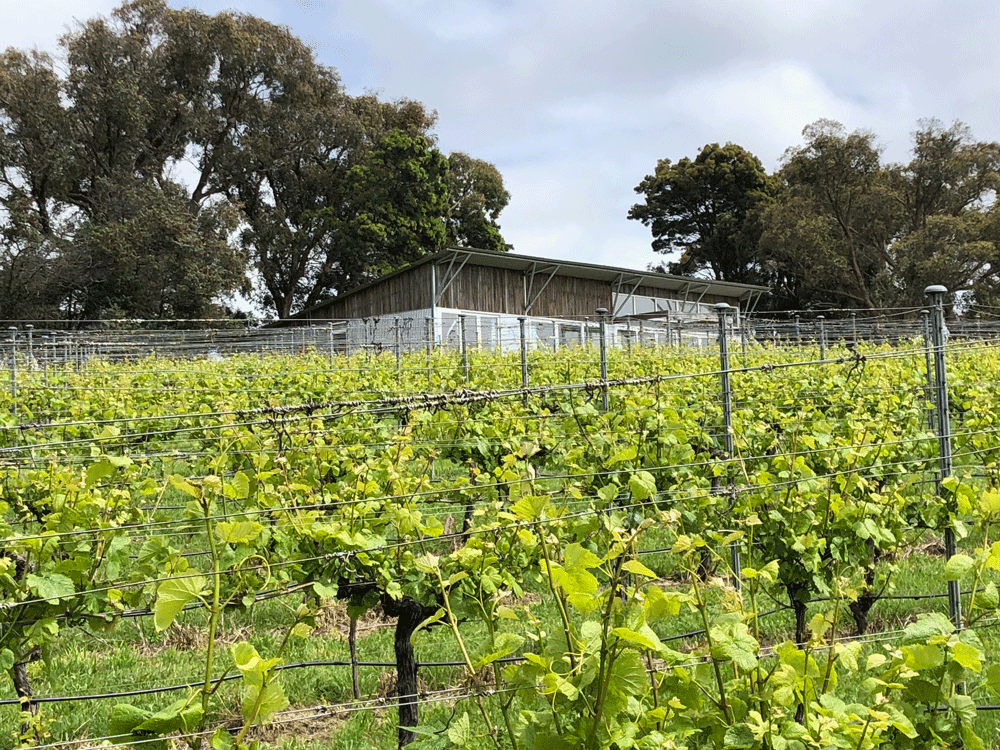
The Vineyard
Hatherleigh Vineyard lies on an east-facing slope above the village of Laggan, near Crookwell, in the Southern Tablelands of New South Wales. The topsoil lies over a red cracking clay derived from Ordovician/Silurian mudstones and siltstones with quartzite inclusions. The soil retains water through spring, but dries in late summer, which is when I want it to.
The vineyard lies at 910 metres altitude, close to the top of the Great Dividing Range. Rainfall is predominantly in the winter and early spring. There is nevertheless significant summer rainfall, but this is mostly from thunderstorms, which dump their rain quickly and then allow the vines to dry out. The area avoids the humid, drizzly weather found in the Southern Highlands, some 90 km to the east. The climate is cool continental, with cold winters, occasional snowfalls and warm summers.
Spring frosts are a frequent danger, but I have taken steps to reduce the worst of the risk.
Vineyard Management
For many years I grew only Pinot Noir which is my passion and, besides, it is the only red grape that would ripen in this cool area. I planted the first few rows of clone MV6 in 1996 and gradually extended them, with the majority of vines planted in 1999. In 2017 and 2019 I grafted Chardonnay, clone 95, over a third of the vineyard and half the remaining Pinot to clone 777. The results to date have been excellent for both.
The vines grow at 2.4m between rows and 1.5m between vines. I cane prune them to about 20 buds per vine and use a strict vertical trellis with shoot-thinning and leaf plucking on the east side before veraison. This management allows good airflow and fruit exposure, and permits me to keep sprays to the minimum. Almost all the sprays I use are organic, including seaweed and orange extracts, although I do not claim organic status. I will use a synthetic spray if difficult weather dictates, as in the 2011, 2021 and 2022 seasons. I use minimal herbicide in a very narrow strip and no synthetic insecticides.
Budburst is almost invariably around the first week of October, flowering in mid-December and veraison – colour change - around the second week of February. My target yield is 4 tonnes from the hectare, but the crop is sometimes reduced by frost and occasionally hail.
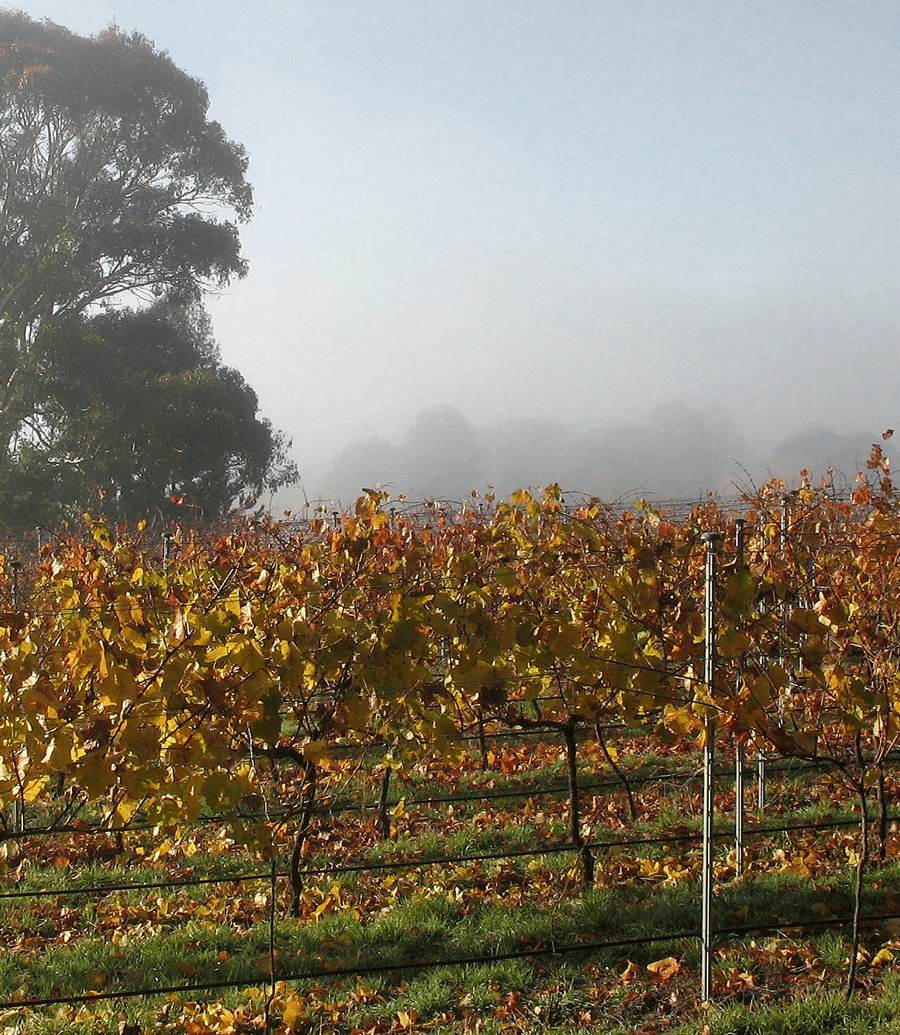
Pinot Noir
I don’t want to confuse or disappoint you, but the grape variety is strictly just Pinot! This includes at least four colour variants – Pinot gris, Pinot blanc, Pinot meunier, some obscure stuff and my favourite, Pinot Noir.
But don’t let that bother us. It’s Pinot noir from now on.
Pinot noir grapes have these characteristics in comparison with most others.
It ripens early, so likes and needs a cool climate.
It’s choosy, and gives its best only in the right region and on the right site.
Now for Pinot noir wines
They are paler than most reds, but don’t be fooled! They have flavour.
They mostly have red fruit flavours – cherry, raspberry, strawberry, but can move into black cherry and plum.
They have a plump, fleshy mid-palate and have fine, often smooth tannins. This usually adds to great balance and suppleness in the mouth.
Some are usually ready to drink soon after bottling, but the best will age for many years.
Now more technical stuff. As I said above, the true variety is Pinot, as the four main variants have the same DNA. It’s recognised as one of the oldest varieties, the earliest records, in Burgundy, being around 1283.
Pinot noir, our red variant, has more tannin in the grape than some others such as Merlot, but the tannins are harder to extract, so Pinot noir wines are generally soft.
It sits well with French oak, but American oak is a no-no.
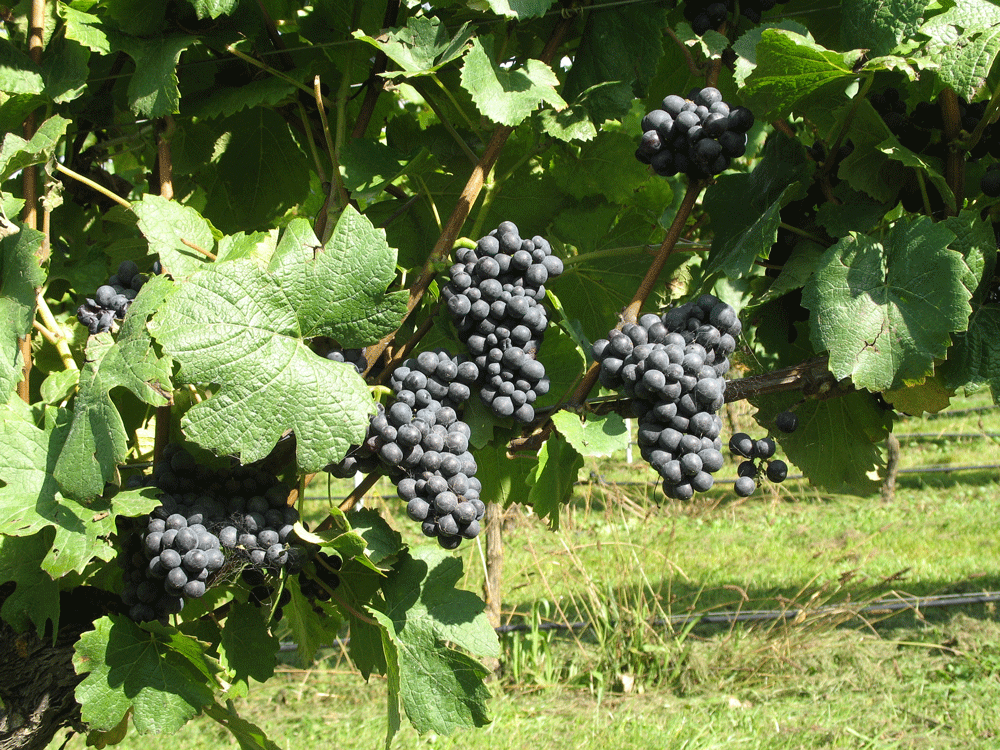
Chardonnay
Chardonnay is much more amenable than Pinot noir, giving wines with characteristic flavours in climates from cold to hot. The flavours change, however, the hotter-grown wines giving tropical flavours, but the spectrum changes as you get progressively cooler, through yellow then white peach, fresh fig, to white nectarine, lemon and eventually apple.
Not fond of Chardonnay? I expect you still remember the over-rich, oaky wines of last century. The best Chardonnay now grows in cooler regions and tends to be picked earlier (so less alcohol). Winemakers have learnt how to handle oak barrels more sensitively and usually use fewer new barrels in the mix. The result is medium not full body, a bigger array of fresh flavours and more texture from talc-like tannins, all making the wines more food-friendly.